

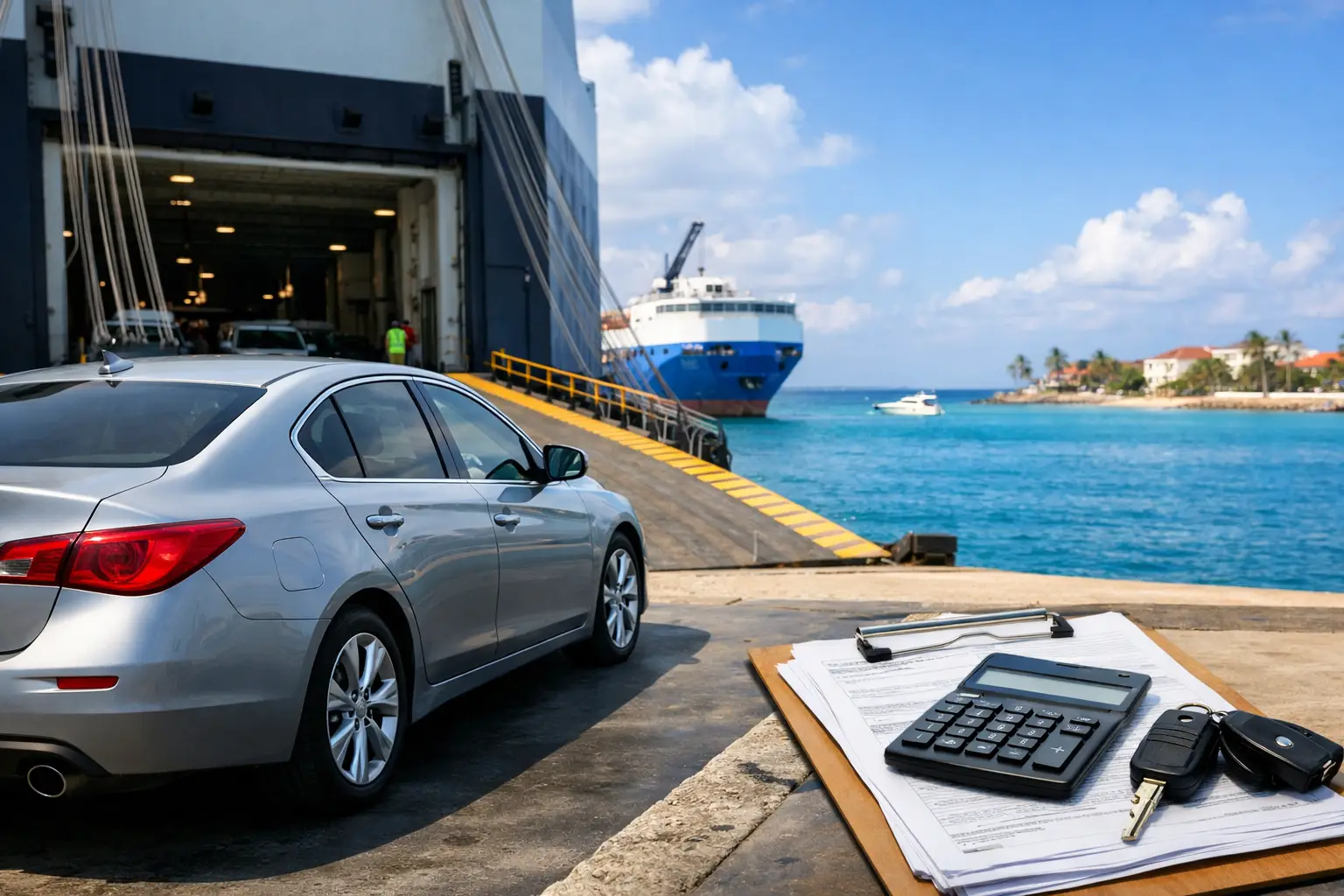
A vehicle can look like an excellent purchase until the costs between the seller’s driveway and your Cayman address begin to surface. So, how much does it cost to import a car to Cayman? The honest answer depends on the vehicle, its declared customs value, its origin, its shipping method, and the taxes and fees that apply at entry. A properly prepared estimate turns that uncertainty into a clear landed-cost figure before you commit to a purchase.
For most buyers, the full import cost is more than the purchase price plus ocean freight. Customs duty, government charges, port handling, clearance work, insurance, registration, and final delivery all need to be accounted for. The goal is not simply to get the vehicle to Grand Cayman. It is to have it arrive compliant, protected, and ready for the road without avoidable delays or surprise charges.
What Makes Up the Cost to Import a Car to Cayman?
Your landed cost begins with the vehicle’s purchase price, but customs calculations generally look at the vehicle’s value together with the cost of freight and insurance. This is often referred to as the CIF value – cost, insurance, and freight. It is the foundation for many import charges, which is why accurate documentation matters from the start.
The main cost categories usually include the following:
- Vehicle purchase price and any dealer, auction, or seller fees
- Export preparation, inland transport, and shipping from the departure port
- Marine cargo insurance, particularly important for luxury, classic, and performance vehicles
- Cayman customs duty and applicable government charges
- Port handling, customs clearance, licensing, registration, and final delivery
Each category can move the final number. A vehicle purchased in South Florida may have a straightforward route to Cayman, while a vehicle sourced farther inland may require enclosed transport, port delivery, and additional export coordination before it ever reaches the vessel.
The Vehicle Value Used for Customs
Customs authorities need a credible declared value for the imported vehicle. A recent purchase invoice is usually the starting point, though the vehicle’s condition, model year, specification, and supporting documentation can all be relevant. For a specialty car, collector vehicle, or a purchase without a conventional retail invoice, valuation deserves particular care.
Trying to understate a vehicle’s value is not a cost-saving strategy. It can create a customs query, delay release, lead to reassessment, or expose the importer to penalties. Clear purchase records, a bill of sale, payment evidence, and vehicle details allow the declaration to be handled with precision.
Shipping Costs From the United States
Shipping is often the first expense buyers ask about, but it varies more than many expect. The route, departure port, vehicle size, timing, and level of handling all affect the price. South Florida is a common and efficient departure point for Cayman-bound vehicles, but the cost to get a vehicle from its seller to Florida must still be included when applicable.
A standard operable sedan may be suitable for a conventional shipping arrangement. A low-clearance performance car, a high-value luxury SUV, or a classic vehicle may require more controlled handling, specialized loading, or enclosed domestic transport. Those choices can add to the upfront cost, but they also reduce the risk of cosmetic damage, mechanical issues, or preventable claims.
Marine cargo insurance should be considered part of a disciplined import plan, not an optional afterthought. The premium is generally modest compared with the value it protects, especially when the vehicle is rare, customized, or difficult to replace.
Customs Duty and Government Charges in Cayman
For many imports, customs duty is the largest cost after the vehicle itself. The applicable rate and any additional charges depend on the vehicle’s classification and the rules in effect when it enters Cayman. Factors such as the vehicle type, fuel type, age, engine characteristics, and customs valuation can affect the final assessment.
Because government rates and exemptions can change, an estimate should be built using current information rather than a generic percentage found online. This is especially true for electric vehicles, hybrids, commercial vehicles, older vehicles, and specialty imports. A vehicle that appears similar to another model may be assessed differently based on its official classification.
It is also essential to distinguish between a shipping quote and a landed-cost quote. A shipping quote may only cover transport from port to port. A landed-cost quote should account for freight, insurance, expected customs charges, port fees, clearance, registration-related costs, and delivery. Comparing the two as though they are the same can make one option appear artificially inexpensive.
A Practical Landed-Cost Example
Consider a buyer purchasing a vehicle in Florida for US$45,000. Before it can be driven in Cayman, the buyer may also need to account for domestic transport to the departure port, export processing, ocean freight, marine insurance, Cayman duty and applicable government charges calculated on the relevant customs value, port charges, customs clearance, and licensing costs.
The final amount is not reliably calculated by adding a flat percentage to US$45,000. Freight and insurance can affect the customs base, while the vehicle’s classification determines how duty and other charges are applied. Currency conversion between US dollars and Cayman Islands dollars must also be handled accurately. This is why an itemized estimate is more useful than a broad statement that import costs are “about” a certain amount.
For a US$100,000 luxury vehicle, the same principle applies at a higher level of exposure. The consequences of a valuation issue, a documentation gap, or inadequate transit protection are greater. Professional coordination is often less about finding the lowest individual line item and more about maintaining control over the entire transaction.
Costs Buyers Commonly Miss
The most avoidable surprises tend to occur outside the freight quote. A seller may charge storage if collection is delayed. An auction purchase may require added documentation or release time. A vehicle with an outstanding finance lien cannot be exported until that interest is properly released. If the title is missing, unsigned, or inconsistent with the bill of sale, clearance can stop until the record is corrected.
Buyers should also plan for local road-readiness requirements. Once the vehicle clears customs, it may need inspection, registration, licensing, and insurance before it can legally be driven. If the vehicle requires modifications, repairs, or replacement parts to meet local requirements, that should be identified before shipping rather than after arrival.
Storage is another cost that can grow quickly. Ports and facilities operate on schedules, and vehicles that cannot be released because paperwork is incomplete may incur charges while the issue is resolved. The most cost-effective import is usually the one planned early enough for every document to be checked before the vehicle departs.
How to Estimate Your Total Cost Before You Buy
Start with the exact vehicle, not a hypothetical model. Obtain the VIN, purchase price, title status, current location, dimensions, condition, and a clear list of any modifications. For an auction vehicle, include buyer fees and the auction’s release requirements. For a dealer purchase, confirm whether taxes, documentation fees, or transport are already included in the sale terms.
Then separate the estimate into three stages: getting the vehicle to the export port, shipping and insuring it to Cayman, and completing customs clearance and local delivery. This structure makes it easier to see which costs are fixed, which are variable, and which depend on the final customs assessment.
Ask for clarity on what is included. Does the quote include inland transport? Is marine insurance included or optional? Does it cover customs coordination and port handling? Is final delivery to your residence included after release? A premium import experience should be transparent at each handoff, not dependent on assumptions buried in a freight quote.
Why Managed Import Coordination Protects the Investment
Importing a vehicle is a chain of connected tasks: purchase verification, collection, shipping arrangements, export documentation, customs declaration, port release, registration support, and local delivery. A failure at one stage can affect the next. For high-value assets, managing those stages separately can create unnecessary gaps in accountability.
A managed partner provides a single point of coordination and keeps the process organized around the vehicle, its documentation, and its delivery deadline. At Waypoint Imports, that means helping clients understand expected landed costs before purchase, coordinating the movement of the vehicle, and guiding clearance through to final delivery with complete professionalism.
The best time to price an import is before money changes hands. Provide the vehicle details early, request a complete estimate, and make the purchase with a clear view of the road ahead. That preparation gives you more than a cost figure – it gives you control over one of the most important parts of the investment.
